Highlights
- Victorian vaccine hub applying the CT Cold Chain Solution to ensure the safe storage of COVID-19 vaccine doses
- Application highlights the importance and challenges of maintaining cold chain integrity
- 12 to 15 billion COVID-19 doses expected to be produced, each requiring temperature and handling monitoring in transit and storage
Constellation Technologies' Cold Chain solution has been deployed to monitor the temperature integrity of Pfizer vaccine doses at Barwon Health's University Hospital Geelong, one of the initial sites in Australia storing vaccines. CT's proprietary Cold Chain solution is now deployed across all Barwon Health departments and facilities in more than 200 refrigeration assets.
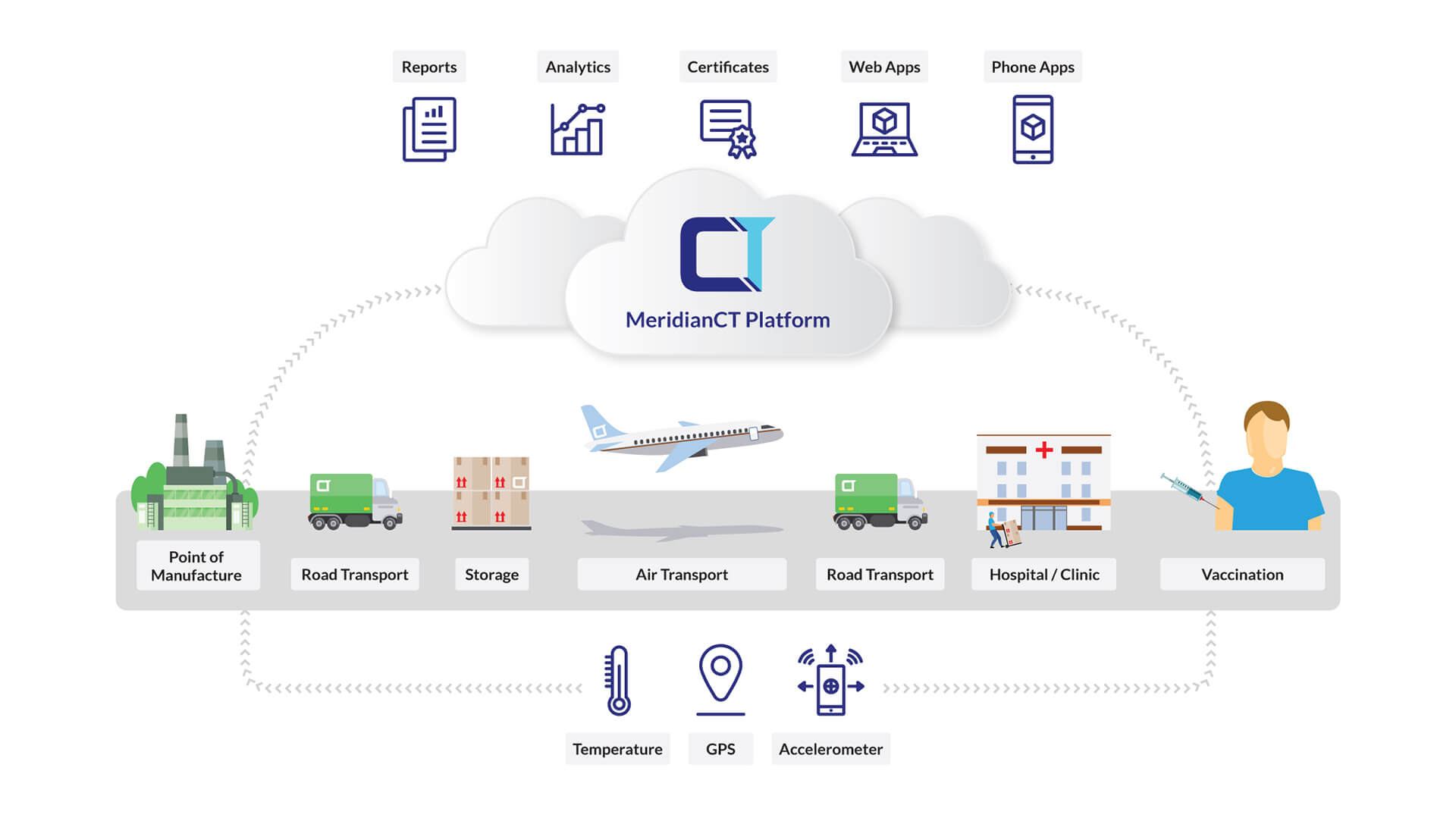
The cold chain is a system of transporting and storing temperature-sensitive products such as vaccines. It begins when the vaccine is manufactured, continues through the vaccine distribution centre across trucking, flights, warehousing and pharmacies, as well as the interchanges at each point, and only ends when the vaccine is administered.
The CT Cold Chain Solution comprises sensors that travel with the vaccine doses on their journey through the cold chain and continuously track temperature, location and handling. Multiple sensors communicate with one central software platform: CT's core IoT platform, the MeridianCT (MCT) Platform.
Complete and continuous monitoring is required to verify that the integrity, and thus the safety and efficacy, of the vaccine has not been compromised in transit and storage by temperature breaches (too hot or too cold) and handling.
According to a previous World Health Organization paper, around half of the vaccines distributed in the world go to waste, in large part because of a failure of the cold chain.1
The challenges that any cold chain monitoring solution must address are listed below, and are addressed through the following features of the CT Cold Chain solution:
- Recognised and verified accuracy at extreme temperatures
- Handling, including shock and location tracking
- Capacity of the software platform to receive and process millions of data records
- Real-time customised alerts and reporting
- Storing and transmitting data, especially during sensitive transit windows such as custodian changes, to maintain a complete, automated and independent verification record
- Connectivity across multiple communications networks to ensure communication stability
- Predictive analytics to identify potential cold chain failures, allowing proactive action to avoid breaches
- Dynamic reporting and viewing platforms to communicate with multiple stakeholders
- Compliance with data security standards
- Scalability of hardware production and platform operational capacity to support global deployment
- Independent power supply and operation of data capture and transmission
Through the global COVID-19 vaccination program, under which 9 billion doses are expected to be produced in 2021 alone, cold chain integrity has become a universal concern with growing community awareness. The MCT platform can provide the third-party data and reporting to verify the success or failure at every point in the cold chain.
The solution has been operational for five years and deployed in multiple countries. It is one of the very few IoT solutions that has undergone NATA (National Association of Testing Authorities) calibration to confirm its ability to monitor extreme temperatures to the requisite accuracy for highly sensitive materials such as vaccines.
In the health sector, the CT Cold Chain Solution currently services a number of hospitals and research facilities in Australia and is working closely with cold chain stakeholders on imminent further deployments to support the rollout of the COVID-19 vaccines.
CT monitoring solution: summary of key features
Hardware
- Standalone system
- No power supply needed (long-lasting rechargeable 5500 mAh battery, about 1 year)
- IP66
- Cat-M1 (Telstra / Vodafone), LoRaWAN, Sigfox
- Built-in sensor (−30 °C to 50 °C)
- Plug-in probe (−80 °C to 200 °C)
- Plug-in humidity sensor
Web and mobile apps
- Push notifications
- Continuous near-real-time dashboards (traffic-light alerting)
- Centralised group monitoring with a three-level organisational hierarchy
- Alert escalations
Artificial intelligence
- Models for predicting failures and detecting anomalies
- Door status alerts
- Compressor failure
Transportation
- GPS location-based dashboards
- Accelerometers (shock detection)
- Geofence reports
- Route monitoring
Digital forms
- Complete digital record keeping using mobile apps
- Convert all paper-based forms to electronic forms
- Monitor submissions and create action lists from form submissions
- Automatic emailing of reports: compliance, daily reporting, verification certificates
- Staff task assignment
- Staff KPIs
- Asset management: equipment maintenance records
Compliance
- HACCP compliance temperature reports
- Corrective actions
- Alert actions
- Customised compliance reports
- World Health Organization, WHO/V&B/03.18 Rev.1 (PDF). ↩